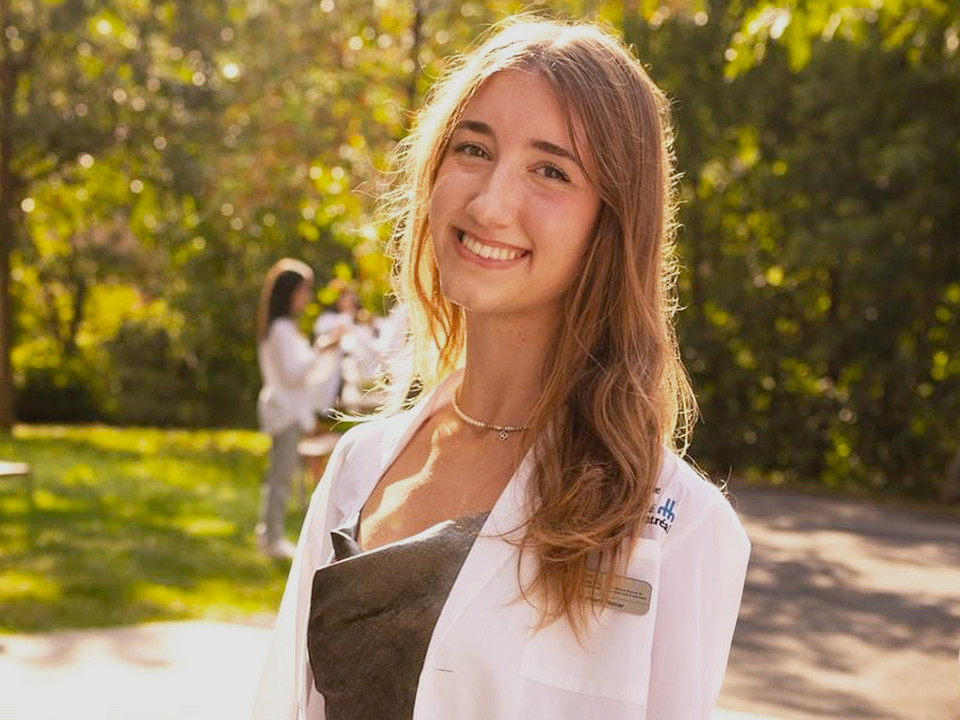
Kimberly Molnar | Quand j’ai commencé à réfléchir à ce que j’allais écrire pour ce concours, je ne voulais pas simplement parler de mes expériences en pharmacie. Je voulais plutôt raconter quelque chose de vrai, une expérience qui m’avait transformée sans que je m’en rende compte sur le moment. C’est ainsi que je me suis rappelée ce cours de cinéma que j’avais suivi au cégep, que j’avais choisi presque par hasard, et qui, étonnamment, m’a appris à écouter autrement. En écrivant ce texte, ma démarche a été de montrer que l’apprentissage pertinent à notre futur rôle de pharmacien ou de pharmacienne ne se fait pas toujours là où on l’attend. Ce cours m’a permis de développer une sensibilité à ce qui n’est pas dit mais qui importe tout de même beaucoup. C’est dans ces moments-là de silences et hésitations chez les patients, parfois subtils, que je vois à quel point cette formation inattendue a façonné ma façon d’entrer en relation. Je voulais aussi rendre hommage à cette idée que la compétence clinique, bien qu’essentielle, n’est pas suffisante à elle seule. Voir le patient comme une personne entière, avec un vécu, un contexte et des émotions, demande un regard différent, un regard que le cinéma m’a appris à cultiver. En partageant cette perspective, j’espérais inviter à réfléchir à la richesse des parcours non conventionnels et à l’importance d’intégrer des expériences variées dans notre formation en santé. |
By Kimberly Molnar
The Class That Had Nothing to Do With Pharmacy Yet Taught Me Everything
I remember sitting in a darkened classroom, watching a black-and-white French film that moved slowly, almost painfully. The characters said little. The silences stretched longer than anything I’d experienced in my science classes. I kept glancing around, wondering if I was missing something. This was my Introduction to Film class, the elective I’d chosen during my second year of CEGEP, hoping for an easy break between chemistry labs and biology classes. I thought it would be a mental vacation. Instead, it cracked open a part of my thinking I didn’t know needed challenging.
We didn’t just watch films, we studied them. We paused scenes, dissected body language, questioned lighting choices, analyzed what wasn’t said. My teacher often reminded us that “Every shot is intentional and every silence matters.” That idea stayed with me.
I have always liked science. I especially liked the fact that it had a certain structure to it. I found comfort in right answers and clear pathways. In the lab, if you followed the protocol, the result made sense. But film class wasn’t like that. It was full of ambiguity, interpretation, emotion. One student could see tragedy in a scene, another hope. The fun yet scary thing was that neither one of them was wrong. Therefore, at first, film class was frustrating. I missed certainty. But slowly, I started to see the value in uncertainty. The more we discussed characters, the more I realized we were really talking about people, including their fears, their histories, their motivations. We were learning to read them, even when they didn’t speak.
Once arrived in pharmacy school, I realized how much of that skill transferred. A patient isn’t a list of symptoms. They don’t arrive with a script. Sometimes, they’re guarded or embarrassed. Sometimes, their real concern is hidden behind what seems like a routine question. And like in film, the silences matter. The body language, the pauses, the tone, yes! It all tells a story.
When I got my first job in a pharmacy, I talked with a patient who came in for a refill of a common antidepressant. She was polite but withdrawn. Everything about the interaction was technically fine, but something about her body language made me pause. Instead of rushing through the handover, I asked a few more questions. That small moment opened the door to a longer conversation. She was struggling with side effects but didn’t think they were “important enough” to bring up. We worked with the pharmacist to adjust her dose and follow up.
That ability to notice what wasn’t being said, to interpret the human side of health, honestly came from my film class. It taught me to sit with discomfort, to resist the urge to categorize too quickly. That’s not always easy in pharmacy, a field driven by evidence and efficiency. But patients aren’t equations. Their health journeys are messy and nonlinear.
Another lesson film taught me was how much context matters. A character’s decision rarely makes sense in isolation. Indeed, you have to understand their backstory, the pressures they’re facing, what they’re afraid of losing. I carry that into pharmacy, too. When a patient refuses a medication, misses doses, or seems unmotivated, it’s tempting to label them as “non-adherent.” But maybe they don’t trust the system. Maybe they’re choosing between food and prescriptions. Maybe they’re simply overwhelmed.
Of course, pharmacy education gave me the clinical knowledge I need to make safe, informed recommendations. However, film class gave me the lens to see the whole person and not just their diagnosis, but rather their narrative. And it’s that narrative that often determines whether care is accepted and ultimately effective.
Looking back, I realize that class was the first time I truly learned how to listen, not just to what people say, but to how they say it. When they hesitate, and what they leave out. In the films we studied, some of the most powerful moments were wordless. I now realize that the same is often true in healthcare.
I once thought being a good pharmacist meant mastering information. Now I believe it also means mastering interpretation, seeing the patient as a story in progress.
I came to that elective expecting a break from my science courses. What I left with was a skill that no textbook could teach: the ability to see. And in a profession that’s as much about people as it is about pills, that might be the most valuable lesson of all.
Lien vers le site du CHN. |
